Our published insights and practical guides for UK businesses. Browse a topic, read the material here, or visit the original LinkedIn or X publication.
Originally published 20 November 2026
Smarter Business Travel: Technology Meets Human Expertise
How technology, experienced travel professionals and financial control work together in corporate travel.
Read the published material
Smarter Business Travel: Technology Meets Human Expertise
Business travel is evolving. AI-powered booking platforms, automated expense management and real-time travel data are making corporate journeys more efficient.
But technology alone cannot replace experienced travel professionals.
When flights are disrupted, itineraries become complicated or travellers need personal support, human expertise remains essential.
And there is another important dimension: financial control.
For businesses managing corporate travel, the real challenge is not simply booking efficiently. It is understanding the full financial impact of every journey.
Effective business travel management combines:
• Smart booking technology and personalised traveller support. • Clear travel budgets and expense visibility. • Better control of supplier costs and spending. • Reliable financial reporting and cash-flow forecasting. • Commercial insight to balance traveller needs, efficiency and cost.
At AU Finance & Advisory, we understand the financial challenges facing UK travel and hospitality businesses.
We help businesses turn financial data into meaningful insights through management accounts, financial control, budgeting and forecasting.
Smart technology improves the journey. Human expertise improves the experience. Financial control protects the business.
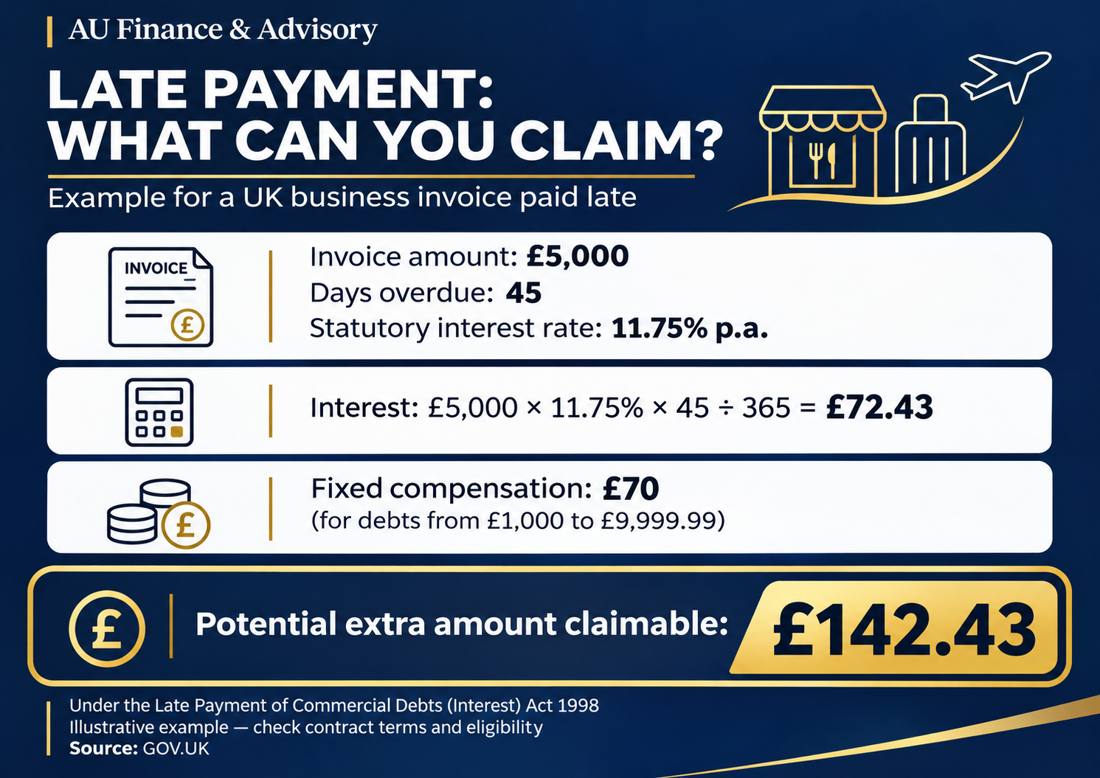
An illustrative calculation of interest and compensation on qualifying overdue commercial invoices.
Read the published material
LATE PAYMENT DOESN'T HAVE TO MEAN LOST MONEY
Did you know that UK businesses may be entitled to claim statutory interest and fixed compensation when commercial invoices are paid late?
Under the Late Payment of Commercial Debts (Interest) Act 1998, qualifying B2B debts can attract statutory interest at 8% above the applicable Bank of England reference rate.
Let's look at a practical example.
A £5,000 invoice became overdue in October 2026 and remained unpaid for 45 days.
Assuming statutory interest applies:
Statutory interest rate: 11.75% per annum
8% + 3.75% (Bank of England reference rate at 30 June 2026)
Total additional amount potentially recoverable: £142.43
The statutory fixed compensation depends on the amount owed: • Under £1,000 — £40 • £1,000 to £9,999.99 — £70 • £10,000 or more — £100
These amounts are in addition to statutory interest where the legislation applies.
Why does this matter?
Late payments can seriously affect working capital, even in otherwise profitable businesses.
Effective credit control, regular debtor reviews and realistic cash flow forecasting help businesses protect liquidity and reduce unnecessary financial pressure.
At AU Finance & Advisory, we help UK businesses strengthen financial control, improve cash flow visibility and make better-informed financial decisions.
Are late-paying customers affecting your business?
Note: Statutory entitlements depend on the circumstances and contractual terms. The example is illustrative.
Paying staff early: check your payroll reporting date
Why the usual contractual payday matters when reporting an early Christmas payroll payment.
Read the published material
Paying staff early for Christmas? Check the date on your payroll submission.
For UK pubs, restaurants and other businesses, December wages may be paid earlier than the normal payday.
HMRC's October 2026 Employer Bulletin confirms a crucial detail: when you pay employees early over Christmas, your Full Payment Submission (FPS) should still show their usual or contractual payday.
For example: • Actual payment: Friday 18 December 2026 • Normal contractual payday: Thursday 31 December 2026 • Date to enter on the FPS: 31 December 2026
Submit the FPS on or before the usual payday.
Why does this matter? Reporting an earlier date can affect employees receiving Universal Credit.
Before December payroll, check: • The usual payday in employees' contracts • The payment date entered in your payroll software • The deadline for submitting the FPS
AU Finance & Advisory helps UK employers manage payroll, PAYE and financial compliance.
Why higher sales targets need realistic cash flow forecasts, funding assumptions and downside scenarios.
Read the published material
UK small businesses are planning for growth again. But can their cash flow keep up?
A new survey of SME finance professionals by UK business lender iwoca, published today, suggests that some British small businesses are becoming more ambitious about growth.
According to the iwoca SME Expert Index:
• 37% of finance professionals surveyed report that their SME clients have increased revenue targets. • 34% report that their clients have raised their hiring ambitions.
These findings reflect the experiences of the professionals surveyed, rather than the UK small business sector as a whole. Nevertheless, they offer an encouraging indication of business confidence.
But growing a business isn't simply about generating more sales.
New customers may mean additional staff, more stock, higher operating costs and more money tied up in unpaid invoices.
A business can be profitable and growing, yet still struggle to pay its bills.
Before committing to expansion, business owners need to consider:
• How much additional working capital will growth require? • Will customer payments arrive in time to cover rising costs? • How will increased spending affect profitability? • What happens if sales grow more slowly than expected?
Growth should create opportunities, not financial pressure.
Successful expansion requires more than ambitious sales targets. It requires realistic cash flow forecasts and a clear understanding of the financial risks.
Booking records, financial protection and cash flow checks for UK travel businesses.
Read the published material
UK travel agents: could your booking arrangements become packages from 6 April 2027?
The amended Package Travel Regulations bring certain arrangements previously classed as Linked Travel Arrangements into the definition of a package. For travel agents and tour operators, this can affect financial protection, responsibilities and financial controls.
Three questions to review: • Can your booking records identify affected arrangements? • Are customer receipts, supplier payments and refunds reconciled? • Can your cash-flow forecast withstand delays in supplier recoveries?
Our new guide explains the practical checks worth making before April 2027.
How overdue customer invoices can put pressure on supplier payments, payroll and business cash flow.
Read the published material
Your customer pays late. Your bills don't wait.
You've delivered the work. Sent the invoice. Met your side of the agreement.
But the payment hasn't arrived.
Meanwhile, your staff need paying, suppliers expect their money, and HMRC deadlines aren't moving.
New research highlighted by the UK Small Business Commissioner this week reveals that 28% of businesses affected by late payments struggled to pay their own bills as a result.
That's the real cost of late payment. It's not just an overdue invoice. It's the pressure it puts on an otherwise healthy business.
Three things every business owner should keep an eye on:
• How much money is tied up in overdue invoices? • How long do customers actually take to pay? • Would your cash flow survive another 30 days without that money?
A profitable business can still run into serious trouble when cash doesn't arrive on time.
Late payments aren't just an administrative nuisance. They're a business risk.
Why professional judgement and verification still matter when accounting work uses AI.
Read the published material
AI is changing accounting. But who checks the AI?
AI can save an enormous amount of time. It can analyse information, process documents, suggest accounting treatments and help with research.
But there's a problem I've encountered myself: AI can give an answer that sounds completely convincing and still be wrong.
In accounting, that matters.
An incorrect VAT treatment, a misclassified transaction or an inaccurate interpretation of HMRC guidance can have consequences well beyond a simple correction in the accounts.
The difficulty isn't always spotting an obvious mistake. It's recognising when something that looks perfectly reasonable needs to be challenged.
I see AI as a valuable tool, but not a substitute for professional judgement, experience and verification.
And I think there's an important question for our profession:
As more accounting work becomes automated, who should ultimately be responsible for checking the result — the software provider, the accountant or the business owner?
I'd be interested to hear how other accountants are approaching this.
Could your VAT accounting method be affecting cash flow?
The timing benefits and trade-offs of VAT cash accounting for eligible businesses.
Read the published material
Could your VAT accounting method be putting unnecessary pressure on cash flow?
Under standard VAT accounting, a business may have to pay VAT on a sales invoice before its customer has paid. HMRC's Cash Accounting Scheme can change that timing for eligible businesses.
Consider an illustrative example: a small consultancy invoices £12,000 including £2,000 VAT, with payment due in 60 days. Under cash accounting, the output VAT would generally be accounted for when payment is received rather than when the invoice is issued.
But there is a trade-off: input VAT on supplier purchases is generally reclaimed only after those suppliers have been paid.
The scheme is not automatically advantageous for every business. Restaurants with mostly immediate card takings, businesses with significant unpaid purchases, and those using other VAT schemes may see little benefit or face different rules.
Before changing methods, compare actual payment patterns, supplier terms and VAT liabilities over several periods.
When did you last review whether your VAT accounting method still suits your business?
A discussion of routine accounting, warning signs and the scope of financial advice.
Read the published material
Your accountant keeps your VAT returns, payroll and annual accounts up to date. But what happens when the figures start telling a worrying story?
Take a restaurant that’s busy most evenings but finding it increasingly difficult to cover its bills. Staff costs have risen, supplier prices are higher, and the bank balance isn’t reflecting all those bookings.
The accounts may be perfectly accurate. The problem is that nobody has discussed what those figures mean for the business.
Of course, preparing accounts and providing ongoing financial advice are different services, with different responsibilities and fees.
But here’s something worth discussing.
If an accountant notices a worrying trend while doing the routine work, should they bring it to the client’s attention, even when advisory services aren’t included in the engagement?
Personally, I think there’s a difference between providing detailed financial advice and simply pointing out something that deserves attention.
I’d be interested to hear what business owners and fellow accountants think. Where would you draw the line?
Digital records, outstanding quarterly updates and the 2026/27 transitional penalty position.
Read the published material
Missed the 7 November MTD quarterly deadline? Here's what matters next.
If you're a sole trader within Making Tax Digital for Income Tax, your second quarterly update was due on 7 November 2026.
HMRC will not issue penalty points for late quarterly updates during the 2026/27 tax year. But that does not mean the reporting obligation has disappeared.
Consider a self-employed café operator recording sales through a till system, expenses in accounting software and supplier payments through a separate bank account.
Before submitting the update, check that records are complete, transactions are correctly categorised and income has not been duplicated. HMRC does not require final tax adjustments at the quarterly stage.
MTD is not simply about pressing Submit. Reliable digital records can also make financial management easier.
If your reporting is behind, review your records and submit the outstanding update as soon as possible.
A short weekly review of forthcoming payments, unpaid sales and unexplained cost increases.
Read the published material
Before Monday begins, ask three questions about your business finances.
1. Which payments are due in the next two weeks — and is the cash actually available? 2. Which customers or bookings are generating revenue but not yet bringing in cash? 3. Which cost has risen recently without anyone reviewing the reason?
You don't need to wait until month-end to spot a problem. A short weekly review of cash, receivables and costs can reveal issues while there's still time to act.
For hospitality and travel businesses, where timing matters as much as margins, these questions are particularly useful.
Which financial number do you check first on a Monday morning?
AU Finance & Advisory #BusinessFinance #HospitalityBusiness #FinancialManagement
How payment timing, supplier deposits and other commitments can separate reported profit from available cash.
Read the published material
Your business is profitable. So why is there no cash in the bank?
Profit and cash are not the same thing.
A hospitality or travel business can report a healthy profit while struggling to cover supplier invoices, VAT or payroll.
The reasons may include: - Customers paying later than expected. - Deposits paid to suppliers months before the final sale. - VAT liabilities building up while cash is being spent elsewhere. - Loan repayments and equipment purchases reducing available funds.
A monthly profit and loss report alone won't reveal the full picture.
The practical step? Review a rolling 13-week cash flow forecast alongside your management accounts.
At AU Finance & Advisory, we help businesses understand not just whether they're profitable, but whether they have the cash to keep moving forward.
Turning accurate accounting records into useful questions about margins, contribution and cash flow.
Read the published material
Your accountant prepares the numbers. But who challenges them?
A set of accurate accounts can tell you what happened last year.
It may not tell you why profitability has deteriorated, which customers are becoming less valuable, or whether your business can afford its next major commitment.
For many growing UK businesses, the gap is not a lack of accounting information. It is a lack of financial interpretation.
Management should be able to answer:
• Which activities generate the strongest contribution? • Where are costs increasing faster than revenue? • How reliable are our next 13 weeks of cash flow? • What happens to profitability if our assumptions prove wrong? • Which decisions require immediate attention?
Financial reporting becomes valuable when it supports decisions — not simply when the numbers reconcile.
Good accounting establishes the facts. Good financial management helps determine what to do next.
Opening a second restaurant: test the financial case
Why an expansion model should include working capital, opening delays and lower-than-forecast sales.
Read the published material
Opening a second restaurant? Growth in revenue does not always mean growth in value.
A successful first location can make expansion look like the obvious next step. But the financial case deserves more scrutiny than a sales forecast.
Consider an illustrative scenario: a new site is expected to generate £750,000 in annual revenue. Before signing a lease, management needs to understand more than its projected operating profit.
What happens if sales are 15% below forecast for the first six months?
How much working capital will be tied up before the site reaches stable trading?
Will the existing business have to fund early losses, recruitment and supplier commitments?
And what is the financial impact if opening takes three months longer than planned?
A robust investment model should connect site-level contribution, capital expenditure, cash flow, funding requirements and downside scenarios.
The objective is not simply to demonstrate that expansion could work. It is to establish whether the business can withstand the risks.
What would be your most important financial test before opening another location?
Restaurant break-even: how many covers do you need?
A worked illustration of contribution per cover and the number of covers needed to meet daily fixed costs.
Read the published material
How many covers does your restaurant need to break even on a quiet Tuesday?
A full dining room isn't the only measure of financial health. Knowing your break-even point helps you make better decisions about staffing, opening hours and menu pricing.
Here's a simple illustration (figures are hypothetical):
• Average revenue per cover, excluding VAT: £30 • Variable costs per cover: £15 • Contribution per cover: £15 • Daily fixed costs: £900
Break-even covers = £900 ÷ £15 = 60.
Below 60 covers, the day doesn't cover those fixed costs. Above 60, each additional cover contributes towards profit, assuming the costs and sales mix stay similar.
Your real number depends on food and drink margins, labour patterns, rent, utilities and other costs — and it can change by day of the week.
At AU Finance & Advisory, we help hospitality businesses turn financial records into practical management information.
Do you know your break-even covers for a typical weekday?
A dated discussion of announced business rates measures and the need to check property eligibility.
Read the published material
Autumn Budget 2026: What could the Business Rates changes mean for your hospitality business?
From April 2027, qualifying hospitality properties in England with a rateable value of up to £18,000 may benefit from 100% Small Business Rates Relief.
For pub, restaurant and hotel operators, this makes it important to review:
• Your property's current rateable value • Eligibility for relief, particularly where multiple premises are involved • The impact on your 2027/28 operating budget and cash flow forecast
Understanding the financial impact now can help businesses plan ahead and make more informed decisions.
Five checks covering bookings, menu margins, staffing, payment timing and downside scenarios.
Read the published material
November is the time to stress-test your December trading plan.
For pubs, restaurants and event venues, a full bookings diary can look reassuring. But it does not tell you whether the month will actually generate healthy profit and cash flow.
Five checks worth making before the festive rush:
1. Bookings vs earned revenue — distinguish confirmed reservations, deposits received and services delivered. 2. Menu gross profit — review margins after promotions, waste and supplier cost changes. 3. Labour planning — forecast staffing costs by shift and expected demand, not only last month's percentage. 4. Payment timing — map supplier due dates and payroll against expected receipts. 5. Downside scenarios — what happens if sales are 10% below plan or labour costs rise by 5%?
A one-page weekly dashboard can help spot issues while there is still time to act.
AU Finance & Advisory supports UK hospitality businesses with management reporting, cost control, financial analysis and cash-flow forecasting.
Which is your biggest festive trading challenge: staffing, margins or cash timing?
Historical accounting records and practical experience of migration to Xero.
Read the published material
Moving from QuickBooks or Sage to Xero?
Our experience includes practice-wide historical data migration: 10 years of records for around 150 clients — sole traders, limited companies and partnerships.
A dated overview of Budget announcements affecting qualifying hospitality properties in England.
Read the published material
England's hospitality businesses: is your 2027/28 business rates forecast ready?
The UK Government's Autumn Budget 2026 (28 October) announced changes for qualifying properties in England from 1 April 2027:
• Business rates relief for eligible pubs, social clubs and most live music venues is set to rise from 15% to 35% in 2027/28 and 2028/29. Live music venues with a rateable value of £1 million or more will remain at 15%. • For businesses eligible for Small Business Rates Relief, the full-relief rateable value threshold for qualifying retail, hospitality and leisure properties will increase from £12,000 to £18,000, with tapered relief up to £21,000. • Annual business rates bill increases for qualifying retail, hospitality and leisure properties will be capped by CPI inflation in 2027/28 and 2028/29. Exceptions include improvements that increase a property's rateable value and the loss of certain other reliefs.
These measures have been announced, but detailed regulations and guidance are still to follow. Eligibility depends on the business and property circumstances; the 35% relief does not apply to ordinary restaurants or cafés simply because they are in hospitality.
For independent pubs, cafés and restaurants, now is the time to review rateable values, property costs and cash-flow forecasts — rather than assume headline relief will automatically apply.
At AU Finance & Advisory, we help UK hospitality businesses assess financial changes and plan with confidence.
Have you reviewed the potential impact on your 2027/28 forecast?
An introduction to our accounting support for UK small businesses, hospitality and travel.
Read the published material
Welcome to Accounting Universe! 🌍 Less paperwork. More progress. We are finance professionals dedicated to supporting small businesses — especially in the pubs, restaurants, and travel industries. Our mission is to take the complexity out of accounting and compliance, so you can focus on what you do best: serving customers, growing your business, and creating great experiences. Follow us for: ✅ Industry-specific insights (hospitality & travel) ✅ Practical accounting and tax tips ✅ Tools that save time and cut stress ✅ Guidance tailored to small business owners At Accounting Universe, we believe accounting should drive progress — not hold it back.